
Market valuation for 1981 five-cent pieces depends heavily on surface preservation and strike quality.
Investment potential within this specific mintage correlates directly with the absence of contact marks.
United States Mint facilities utilized standard planchets for nickel production throughout 1981.
Metal composition remains consistent with mid-twentieth-century standards.
Spoiler: Coins falling below the MS63 grade trade at face 1981 Nickel value.
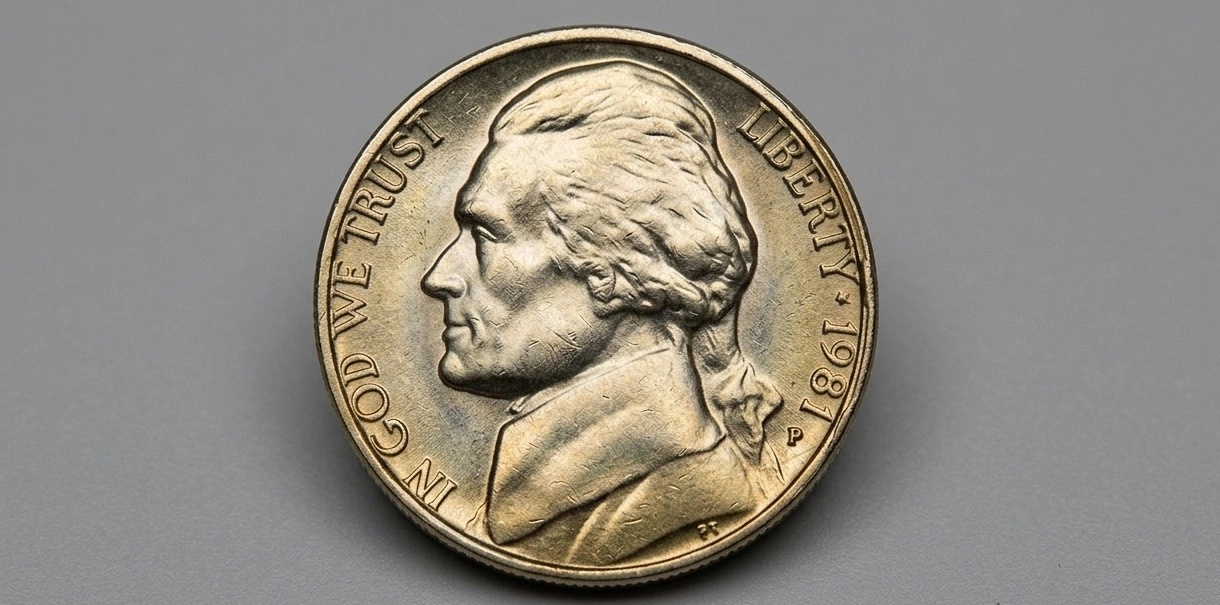
| Parameter | Metric Value |
| Mass | 5.00 grams |
| Diameter | 21.20 millimeters |
| Thickness | 1.95 millimeters |
| Metal | Copper-Nickel |
| Edge | Plain |
Mass deviations exceeding 0.15 grams indicate excessive wear or manufacturing errors.
Production Statistics and Mintages
Three primary facilities distributed the 1981 production run.
Letter designations on the obverse signify the specific place of manufacture.
- Philadelphia showing P mint mark → 657,504,000 units
- Denver showing D mint mark → 419,844,245 units
- San Francisco showing S mint mark → 4,063,083 units
Total mintage exceeds one billion individual specimens.
High market supply limits price growth for coins found in circulated condition.
Sheldon Scale Classification
Professional grading provides the only legitimate method for establishing price.
Relief preservation levels follow a seventy-point numerical system.
- MS67. Perfect luster showing zero visible scratches.
- MS65. High detail displaying minimal contact marks.
- AU58. Slight friction appearing on the highest points of the portrait.
- XF40. Sharp hair lines and distinct columns on the Monticello building.
- VF20. Noticeable flattening while maintaining legible inscriptions.
Price Dynamics as of March 2026
Uncirculated specimen values demonstrate stability in the current decade.
Inflationary processes adjust prices for rare grades only slightly.
| Condition | 1981-P Price | 1981-D Price | 1981-S Proof Price |
| MS64 | $3 | $3 | — |
| MS65 | $12 | $15 | — |
| MS66 | $45 | $55 | — |
| MS67 | $480 | $520 | — |
| PR69 | — | — | $18 |
| PR70 | — | — | $165 |
Annual value growth for the MS67 category averages 4.5% over the last three years.
Sudden 30% price drops occur upon discovering fingerprints or cleaning signs.
Factors Influencing Market Value
Various defects and striking characteristics impact final buyer demand.
Evaluation processes involve inspecting five main zones on the obverse and reverse.
Presence of Full Steps on the building → 200% price increase Absence of original mint luster → Value drop to face value Oxidation of the Copper-Nickel surface → 60% liquidity loss Mechanical hits on the edge → 15% price reduction
Attractive natural toning adding 10% to the base value happens during auction bidding, you can check it with the coin identifier app free.
Record Sales and Auction Data
Maximum prices occur during the sale of coins in exceptional states.
Auction protocols confirm these specific achievements for the 1981 series.
- A 1981-D specimen graded MS67 Full Steps sold for $1,650.
- One 1981-P coin in the same grade reached $1,140.
- Recent 1981-S Type 2 Proof sets traded at $320 in early 2026.
Price differences between the first and second S mark versions reach 400%.
San Francisco Mint Mark Varieties
Two different punch styles identified the S mark on mirror-finish coins in 1981.
Type identification remains a critical task for serious collectors.
Type 1 → Filled or indistinct S mark Type 2 → Clear S mark featuring sharp serifs
The second type of coins, appearing less frequently, cost significantly more at equal quality levels.
Minting Errors and Investment Value
Production cycle mistakes create unique objects for financial placement.
Error pricing depends entirely on the visual intensity of the anomaly.
- Off-center strike. Valued from $25 per 10% deviation.
- Double strike. Reaching $350 when the date remains visible.
- Missing Copper-Nickel layer. Rare occurrence for this year.
- Die crack. Adding between $5 and $50 to the base price.
Minor irregularities not recognized as true errors fail to increase value.
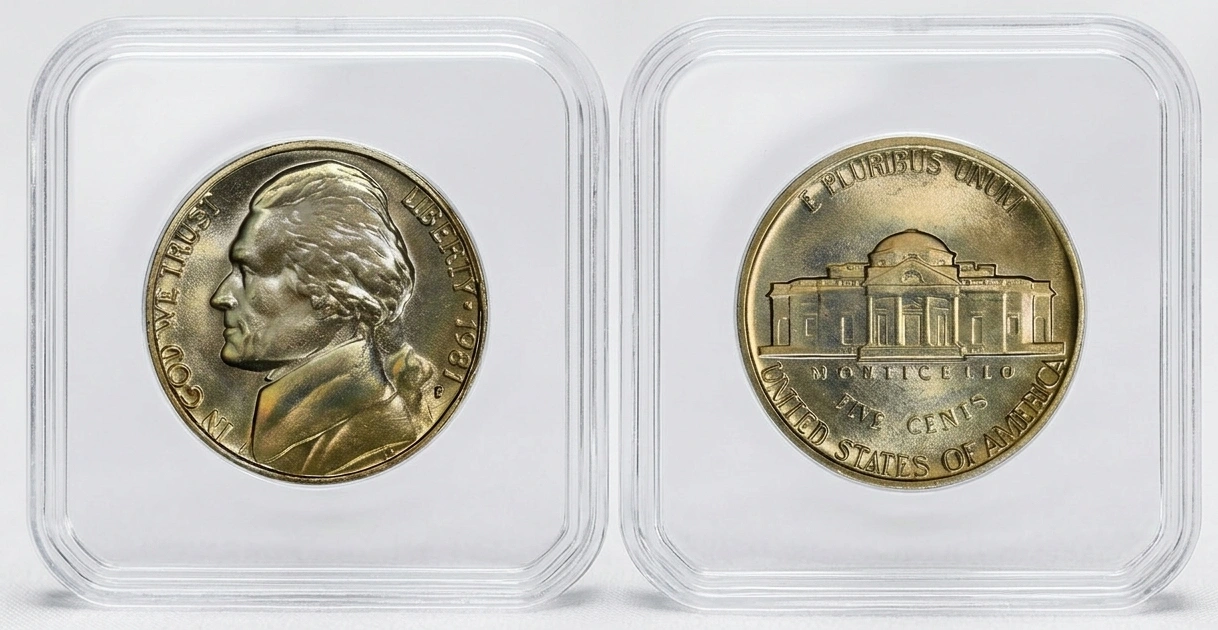
Preservation and Environmental Conditions
Environmental chemical activity destroys surface integrity over time.
Long-term oxygen contact causes metal darkening.
High air humidity → Corrosion development → 2-3 point grade reduction. PVC album storage → Green residue appearance → Complete loss of value. Acid-free holder usage → Luster preservation → Market position maintenance.
Airtight capsules provide maximum protection for up to fifty years.
Circulation Wear Analysis
Most 1981 nickels entered active commercial circulation.
Mass loss during usage reduces the physical value of the object.
Weight 5.00g to 4.95g → Condition nearing perfection. Weight 4.95g to 4.80g → Average wear levels. Weight below 4.70g → Heavy wear showing lost relief details.
Losing 5% of original weight makes a coin unsuitable for professional grading.
Relative Rarity Comparison
Comparing the 1981 mintage with neighboring years helps define its market niche.
Survival rates for high-quality specimens dictate current liquidity.
| Year of Issue | Total Mintage | MS66 Availability |
| 1980 | 1,095,000,000 | High |
| 1981 | 1,077,000,000 | Medium |
| 1982 | 666,000,000 | Low |
Lower 1982 mintages make 1981 nickels less attractive for long-term holding.
Self-Examination Procedures
Initial inspection allows filtering coins lacking numismatic premiums.
Action algorithm for checking a found specimen:
Surface cleaning using a soft cloth without chemicals. Using a free coin identifier and value app. Counting full steps at the Monticello entrance. Comparing luster against reference images from registries.
Discovering tiny scratches in the coin field prevents obtaining an MS67 grade.
Authenticity Verification Methodology
Counterfeiting 1981 nickels happens rarely due to low base costs.
Rare grades and specific S mark types might become targets for manipulation.
Checking weight on electronic scales accurate to 0.01 grams. Studying letter and digit shapes under a microscope. Analyzing metal structure using spectrometers.
Date font mismatches compared to original dies indicate counterfeit status.